
You are using an out of date browser. It may not display this or other websites correctly.
You should upgrade or use an alternative browser.
You should upgrade or use an alternative browser.
Which user would you go on a date with?
- Thread starter MistHunter
- Start date

- Joined
- Feb 23, 2025
- Messages
- 88
- Level up in
- 12 posts
- Reaction score
- 1,092
- Points
- 2,977
"Are you Sakuya? Because every time I look at you, time stops."
D
Deleted member 3099
Guest
"I must be a beaver, because I'm craving that wood"
- Joined
- Feb 23, 2025
- Messages
- 88
- Level up in
- 12 posts
- Reaction score
- 1,092
- Points
- 2,977
Hey, do you like peaches? I heard all celestials do, but I never thought I'd get to ask one.
(I found a bunch of touhou ones heh)
(I found a bunch of touhou ones heh)

D
Deleted member 3099
Guest

- Joined
- Feb 23, 2025
- Messages
- 88
- Level up in
- 12 posts
- Reaction score
- 1,092
- Points
- 2,977
"Let's make this night imperishable"
- Joined
- Feb 23, 2025
- Messages
- 88
- Level up in
- 12 posts
- Reaction score
- 1,092
- Points
- 2,977
"Baby, you're a perfect cherry blossom in this imperishable night, and I have a mountain of faith that you and I could be an undefined fantastic object."

- Joined
- Jan 31, 2025
- Messages
- 1,275
- Level up in
- 1225 posts
- Reaction score
- 6,638
- Points
- 4,577
Tried to watch Avatar 2, but fell asleep about 30 mins in.So... seen any good movies, lately?
Just like the first time i watched Avatar 1.
Gave up, and just watched High Boi's summary.
- Joined
- Feb 16, 2025
- Messages
- 2,363
- Level up in
- 137 posts
- Reaction score
- 11,421
- Points
- 6,077
In an era dominated by the superficial thrills of mainstream horror, Crimson, helmed by none other than the polymathic Faze Rug, emerges as an unexpected revelation—an audacious foray into the labyrinthine psyche of fear itself. To call Crimson merely a horror film would be akin to labeling The Shining a "scary hotel movie." It is, in fact, a philosophical meditation on terror, masked behind the guise of a slasher flick, one that demands deep reflection and intense scrutiny.
From the opening sequence, Crimson ensnares its audience with a visceral blend of operatic visuals and subtle, almost imperceptible tension. The eponymous clown, a grotesque figure painted in strokes of both maniacal glee and tragedy, transcends the mere trope of the killer clown. Here, the character becomes a symbol—an embodiment of the darkness that resides within all of us, whispering that our deepest fears are not external, but inherent. The clown is not simply a harbinger of death, but a philosophical mirror that reflects our own anxiety, our existential fragility, and ultimately, our inescapable need for chaos.
The narrative itself unfolds with deliberate pacing, masterfully constructed to confound the audience’s expectations. Unlike the jarring, overproduced jump scares that define so many of the genre’s failures, Crimson invites us into its world with a slow burn—an almost hypnotic pull that builds until the viewer is engulfed by an overwhelming sense of dread. It is a deliberate dismantling of the conventional horror framework, where each scene feels less like a traditional "moment of fright" and more like a visual allegory for the decay of sanity.
The performances—though one might expect a degree of amateurism given the film’s unconventional origins—are stunning in their complexity. Faze Rug, in his surprisingly poignant turn as the malevolent force at the heart of the film, infuses his character with a haunting sincerity. His clown is not simply a man in makeup, but a tortured soul whose very existence is a cry for attention in an indifferent universe. Rug’s mastery of the nuanced interplay between innocence and malice is nothing short of revelatory, capturing the essence of horror with a gravitas rarely seen in contemporary horror films.
The cinematography of Crimson is nothing short of revelatory. Every frame feels meticulously crafted, each shadow pregnant with meaning, each flicker of light a commentary on the duality of human nature. The film uses color as a language unto itself—Crimson, the title, is not merely a color but a thematic key. It represents the blood that unites and divides, the passion that both ignites and consumes, and the very visceral core of human violence.
Yet, it is the film’s final act that seals its place as a towering achievement in the annals of horror history. What begins as a chillingly psychological exploration of terror morphs into a tragic, almost Shakespearean denouement, where the boundaries between horror, pity, and catharsis blur into a singular, unparalleled cinematic experience. The audience is left not with the comforting release of terror but with the unnerving sense that Crimson is but a reflection of our own psychological nightmare—one that we cannot escape.
In the end, Crimson stands as a testament to the transformative power of horror, a genre that, when in the hands of a visionary, can transcend its genre trappings to become something profoundly more. Faze Rug, in his foray into filmmaking, has crafted not just a horror movie, but a disturbing meditation on the nature of fear, identity, and the human condition. One cannot help but wonder if we, too, are not merely audience members, but trapped within the very nightmare that Rug has so masterfully created.
In Crimson, the question is not if you are afraid, but rather: are you ready to confront the terror that lurks not in the world outside, but in the deepest recesses of your own mind?
From the opening sequence, Crimson ensnares its audience with a visceral blend of operatic visuals and subtle, almost imperceptible tension. The eponymous clown, a grotesque figure painted in strokes of both maniacal glee and tragedy, transcends the mere trope of the killer clown. Here, the character becomes a symbol—an embodiment of the darkness that resides within all of us, whispering that our deepest fears are not external, but inherent. The clown is not simply a harbinger of death, but a philosophical mirror that reflects our own anxiety, our existential fragility, and ultimately, our inescapable need for chaos.
The narrative itself unfolds with deliberate pacing, masterfully constructed to confound the audience’s expectations. Unlike the jarring, overproduced jump scares that define so many of the genre’s failures, Crimson invites us into its world with a slow burn—an almost hypnotic pull that builds until the viewer is engulfed by an overwhelming sense of dread. It is a deliberate dismantling of the conventional horror framework, where each scene feels less like a traditional "moment of fright" and more like a visual allegory for the decay of sanity.
The performances—though one might expect a degree of amateurism given the film’s unconventional origins—are stunning in their complexity. Faze Rug, in his surprisingly poignant turn as the malevolent force at the heart of the film, infuses his character with a haunting sincerity. His clown is not simply a man in makeup, but a tortured soul whose very existence is a cry for attention in an indifferent universe. Rug’s mastery of the nuanced interplay between innocence and malice is nothing short of revelatory, capturing the essence of horror with a gravitas rarely seen in contemporary horror films.
The cinematography of Crimson is nothing short of revelatory. Every frame feels meticulously crafted, each shadow pregnant with meaning, each flicker of light a commentary on the duality of human nature. The film uses color as a language unto itself—Crimson, the title, is not merely a color but a thematic key. It represents the blood that unites and divides, the passion that both ignites and consumes, and the very visceral core of human violence.
Yet, it is the film’s final act that seals its place as a towering achievement in the annals of horror history. What begins as a chillingly psychological exploration of terror morphs into a tragic, almost Shakespearean denouement, where the boundaries between horror, pity, and catharsis blur into a singular, unparalleled cinematic experience. The audience is left not with the comforting release of terror but with the unnerving sense that Crimson is but a reflection of our own psychological nightmare—one that we cannot escape.
In the end, Crimson stands as a testament to the transformative power of horror, a genre that, when in the hands of a visionary, can transcend its genre trappings to become something profoundly more. Faze Rug, in his foray into filmmaking, has crafted not just a horror movie, but a disturbing meditation on the nature of fear, identity, and the human condition. One cannot help but wonder if we, too, are not merely audience members, but trapped within the very nightmare that Rug has so masterfully created.
In Crimson, the question is not if you are afraid, but rather: are you ready to confront the terror that lurks not in the world outside, but in the deepest recesses of your own mind?
- Joined
- Sep 24, 2024
- Messages
- 1,085
- Level up in
- 1415 posts
- Reaction score
- 6,332
- Points
- 3,577
And on a scale of 1 to 10, how goonable is it?In an era dominated by the superficial thrills of mainstream horror, Crimson, helmed by none other than the polymathic Faze Rug, emerges as an unexpected revelation—an audacious foray into the labyrinthine psyche of fear itself. To call Crimson merely a horror film would be akin to labeling The Shining a "scary hotel movie." It is, in fact, a philosophical meditation on terror, masked behind the guise of a slasher flick, one that demands deep reflection and intense scrutiny.
From the opening sequence, Crimson ensnares its audience with a visceral blend of operatic visuals and subtle, almost imperceptible tension. The eponymous clown, a grotesque figure painted in strokes of both maniacal glee and tragedy, transcends the mere trope of the killer clown. Here, the character becomes a symbol—an embodiment of the darkness that resides within all of us, whispering that our deepest fears are not external, but inherent. The clown is not simply a harbinger of death, but a philosophical mirror that reflects our own anxiety, our existential fragility, and ultimately, our inescapable need for chaos.
The narrative itself unfolds with deliberate pacing, masterfully constructed to confound the audience’s expectations. Unlike the jarring, overproduced jump scares that define so many of the genre’s failures, Crimson invites us into its world with a slow burn—an almost hypnotic pull that builds until the viewer is engulfed by an overwhelming sense of dread. It is a deliberate dismantling of the conventional horror framework, where each scene feels less like a traditional "moment of fright" and more like a visual allegory for the decay of sanity.
The performances—though one might expect a degree of amateurism given the film’s unconventional origins—are stunning in their complexity. Faze Rug, in his surprisingly poignant turn as the malevolent force at the heart of the film, infuses his character with a haunting sincerity. His clown is not simply a man in makeup, but a tortured soul whose very existence is a cry for attention in an indifferent universe. Rug’s mastery of the nuanced interplay between innocence and malice is nothing short of revelatory, capturing the essence of horror with a gravitas rarely seen in contemporary horror films.
The cinematography of Crimson is nothing short of revelatory. Every frame feels meticulously crafted, each shadow pregnant with meaning, each flicker of light a commentary on the duality of human nature. The film uses color as a language unto itself—Crimson, the title, is not merely a color but a thematic key. It represents the blood that unites and divides, the passion that both ignites and consumes, and the very visceral core of human violence.
Yet, it is the film’s final act that seals its place as a towering achievement in the annals of horror history. What begins as a chillingly psychological exploration of terror morphs into a tragic, almost Shakespearean denouement, where the boundaries between horror, pity, and catharsis blur into a singular, unparalleled cinematic experience. The audience is left not with the comforting release of terror but with the unnerving sense that Crimson is but a reflection of our own psychological nightmare—one that we cannot escape.
In the end, Crimson stands as a testament to the transformative power of horror, a genre that, when in the hands of a visionary, can transcend its genre trappings to become something profoundly more. Faze Rug, in his foray into filmmaking, has crafted not just a horror movie, but a disturbing meditation on the nature of fear, identity, and the human condition. One cannot help but wonder if we, too, are not merely audience members, but trapped within the very nightmare that Rug has so masterfully created.
In Crimson, the question is not if you are afraid, but rather: are you ready to confront the terror that lurks not in the world outside, but in the deepest recesses of your own mind?
D
Deleted member 3099
Guest
Mate, you can't just drop peak on these people with no warning!In an era dominated by the superficial thrills of mainstream horror, Crimson, helmed by none other than the polymathic Faze Rug, emerges as an unexpected revelation—an audacious foray into the labyrinthine psyche of fear itself. To call Crimson merely a horror film would be akin to labeling The Shining a "scary hotel movie." It is, in fact, a philosophical meditation on terror, masked behind the guise of a slasher flick, one that demands deep reflection and intense scrutiny.
From the opening sequence, Crimson ensnares its audience with a visceral blend of operatic visuals and subtle, almost imperceptible tension. The eponymous clown, a grotesque figure painted in strokes of both maniacal glee and tragedy, transcends the mere trope of the killer clown. Here, the character becomes a symbol—an embodiment of the darkness that resides within all of us, whispering that our deepest fears are not external, but inherent. The clown is not simply a harbinger of death, but a philosophical mirror that reflects our own anxiety, our existential fragility, and ultimately, our inescapable need for chaos.
The narrative itself unfolds with deliberate pacing, masterfully constructed to confound the audience’s expectations. Unlike the jarring, overproduced jump scares that define so many of the genre’s failures, Crimson invites us into its world with a slow burn—an almost hypnotic pull that builds until the viewer is engulfed by an overwhelming sense of dread. It is a deliberate dismantling of the conventional horror framework, where each scene feels less like a traditional "moment of fright" and more like a visual allegory for the decay of sanity.
The performances—though one might expect a degree of amateurism given the film’s unconventional origins—are stunning in their complexity. Faze Rug, in his surprisingly poignant turn as the malevolent force at the heart of the film, infuses his character with a haunting sincerity. His clown is not simply a man in makeup, but a tortured soul whose very existence is a cry for attention in an indifferent universe. Rug’s mastery of the nuanced interplay between innocence and malice is nothing short of revelatory, capturing the essence of horror with a gravitas rarely seen in contemporary horror films.
The cinematography of Crimson is nothing short of revelatory. Every frame feels meticulously crafted, each shadow pregnant with meaning, each flicker of light a commentary on the duality of human nature. The film uses color as a language unto itself—Crimson, the title, is not merely a color but a thematic key. It represents the blood that unites and divides, the passion that both ignites and consumes, and the very visceral core of human violence.
Yet, it is the film’s final act that seals its place as a towering achievement in the annals of horror history. What begins as a chillingly psychological exploration of terror morphs into a tragic, almost Shakespearean denouement, where the boundaries between horror, pity, and catharsis blur into a singular, unparalleled cinematic experience. The audience is left not with the comforting release of terror but with the unnerving sense that Crimson is but a reflection of our own psychological nightmare—one that we cannot escape.
In the end, Crimson stands as a testament to the transformative power of horror, a genre that, when in the hands of a visionary, can transcend its genre trappings to become something profoundly more. Faze Rug, in his foray into filmmaking, has crafted not just a horror movie, but a disturbing meditation on the nature of fear, identity, and the human condition. One cannot help but wonder if we, too, are not merely audience members, but trapped within the very nightmare that Rug has so masterfully created.
In Crimson, the question is not if you are afraid, but rather: are you ready to confront the terror that lurks not in the world outside, but in the deepest recesses of your own mind?
Anyway, I see your Crimson and raise you Clownado.
(I just now realized the clown bleeds confetti)

- Joined
- Feb 15, 2025
- Messages
- 2,291
- Level up in
- 209 posts
- Solutions
- 2
- Reaction score
- 16,010
- Points
- 4,477
- Location
- The Republic of Vesper-Messina
Can I get the Faze Rug and Bath Matt combo?
- Joined
- Feb 16, 2025
- Messages
- 2,363
- Level up in
- 137 posts
- Reaction score
- 11,421
- Points
- 6,077
You know that one Randy Marsh scene? Pretty much.And on a scale of 1 to 10, how goonable is it?
- Joined
- Sep 24, 2024
- Messages
- 1,085
- Level up in
- 1415 posts
- Reaction score
- 6,332
- Points
- 3,577
That was a hilarious episode.You know that one Randy Marsh scene? Pretty much.
- Joined
- Feb 15, 2025
- Messages
- 2,291
- Level up in
- 209 posts
- Solutions
- 2
- Reaction score
- 16,010
- Points
- 4,477
- Location
- The Republic of Vesper-Messina
Drive Thru is another cheesy horror flick to add to the rich tapestry of clown-centric cinema.In Crimson, the question is not if you are afraid, but rather: are you ready to confront the terror that lurks not in the world outside, but in the deepest recesses of your own mind?
Every time the killer is recorded moving the footage is sped up and nu-metal plays over the top of it. Magnifique
- Joined
- Feb 16, 2025
- Messages
- 2,363
- Level up in
- 137 posts
- Reaction score
- 11,421
- Points
- 6,077
DUDE I WATCHED DRIVE THRU LIKE TWO DAYS AGO WTF!Drive Thru is another cheesy horror flick to add to the rich tapestry of clown-centric cinema.
Every time the killer is recorded moving the footage is sped up and nu-metal plays over the top of it. Magnifique
View attachment 48402
When the bully’s boyfriend gets his head cut in half and you see his tongue writhe that fucking got me! Such a good film.
- Joined
- Feb 15, 2025
- Messages
- 2,291
- Level up in
- 209 posts
- Solutions
- 2
- Reaction score
- 16,010
- Points
- 4,477
- Location
- The Republic of Vesper-Messina
That's the bit that always gets me too! That and the head popping in the microwave, a-dayum.When the bully’s boyfriend gets his head cut in half and you see his tongue writhe that fucking got me! Such a good film.
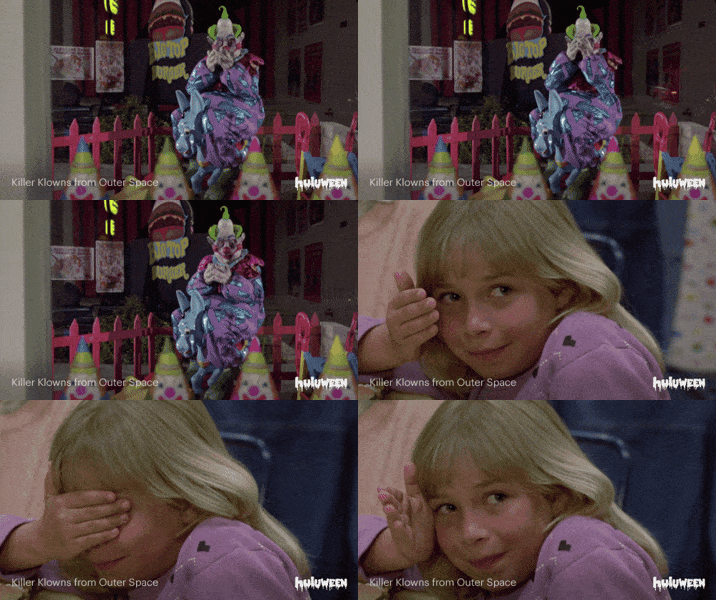
I remember Amusement was another one that came out around the same time...and ofc we can't forget the OG Killer Klownz from Outer Space


- Joined
- Sep 24, 2024
- Messages
- 1,085
- Level up in
- 1415 posts
- Reaction score
- 6,332
- Points
- 3,577


- Joined
- Jan 13, 2025
- Messages
- 1,350
- Level up in
- 1150 posts
- Reaction score
- 4,069
- Points
- 4,477
I watched The Crazies last Saturday.So... seen any good movies, lately?
It's gud.
- Joined
- Feb 15, 2025
- Messages
- 2,291
- Level up in
- 209 posts
- Solutions
- 2
- Reaction score
- 16,010
- Points
- 4,477
- Location
- The Republic of Vesper-Messina
Throw me a date?
*Psst* I hear you both like them Nintendo games!When do I get a date?
- Joined
- Sep 24, 2024
- Messages
- 1,085
- Level up in
- 1415 posts
- Reaction score
- 6,332
- Points
- 3,577
I've been meaning to drop a huge rant about the new Ren & Stimpy reboot show that I recently watched in one of the TV threads, but I can actually just sum my thoughts in one sentence here:

"It's like a show made by people who had the Ren & Stimpy franchise described to them, but never actually watched it."
– Gorse, 2025
It's not so much atrocious as it is bland, which is probably the worst possible thing it could have been. Adult Party Cartoon is far better than this slop, and deserves a critical re-evaluation in the modern age. I'm 100% sure Paramount will be writing it off this year for its taxes. OH WELL
"It's like a show made by people who had the Ren & Stimpy franchise described to them, but never actually watched it."
– Gorse, 2025
It's not so much atrocious as it is bland, which is probably the worst possible thing it could have been. Adult Party Cartoon is far better than this slop, and deserves a critical re-evaluation in the modern age. I'm 100% sure Paramount will be writing it off this year for its taxes. OH WELL
- Joined
- Feb 15, 2025
- Messages
- 2,291
- Level up in
- 209 posts
- Solutions
- 2
- Reaction score
- 16,010
- Points
- 4,477
- Location
- The Republic of Vesper-Messina
And whilst we're at it, why do Mickey, Goofy and Donald look like strung-out tweakers in the new Disney cartoons?!Cartoon is far better than this slop, and deserves a critical re-evaluation in the modern age. I'm 100% sure Paramount will be writing it off this year for its taxes. OH WELL
Users who are viewing this thread
Total: 58 (members: 0, guests: 58)
Support this Site
RGT relies on you to stay afloat. Help covering the site costs and get some pretty Level 7 perks too.
Featured Video
Latest Threads
Air Hockey!
- Samantha
- The Arcade
- Replies: 4
I just noticed that there was an "Air Hockey" tag in here and you bet your sweet ass you are...
Read more
Worst arcade machine you ever played?
- Samantha
- The Arcade
- Replies: 8
Yes, we all have tales about wasting our money on unplayable junk.
That's one of gaming's most...
Read more
That's one of gaming's most...
Most helpful gaming tips you ever came across?
- Need4Power
- General Gaming Discussion
- Replies: 10
What are some of the most helpful gaming tips you ever came across?
First in mind for me is the...
Read more
First in mind for me is the...
Which one actor should play Cecil Stedman in INVINCIBLE.
- The_Dark_Knight
- Movies & TV
- Replies: 3
I only have four actors to choose from. So which one do you think?

Read more
What's your opinion on "All Grown Up!"?
- Luke_fumacigas
- Cartoons & Comics
- Replies: 17
Eu não gostei muito antigamente e descobri o desenho grotesco, provavelmente por causa do estilo...
Read more
Online statistics
- Members online
- 264
- Guests online
- 3,755
- Total visitors
- 4,019
Totals may include hidden visitors.
Forum statistics
Members online
- Generic Edgelord
- Dreamcaster64
- Haider3
- Foodz
- UnfamedAsterisk
- iPuppy
- VidiyaGaemer
- underkusumi
- CookieEater1000
- ItsGuffy
- ArthurLK
- punkdog
- kinkonsito
- Zahir
- Sarahchan1
- TruxtonTatsujin
- Eiha
- richterw
- fryatt420413
- chelnov99
- Lod 10
- Wag77
- Antaeus
- Robfitz
- potpot0893
- ArchienineZXAdvent
- WeAreAmalia
- Papage
- CosmicSadist
- IZMA
- Crescentwench
- RadianceAlesta
- Luciano Tavares
- JayneVEVO
- obodan
Total: 4,019 (members: 264, guests: 3,755)


