Uhm, so this thread just happened...

DinoRexMax DinoRexMax

Saviour of the planet Earth
Level 5
3%
Joined
Jan 26, 2025
Messages
1,047
Level up in
1453 posts
Reaction score
2,448
Points
4,477
Location
Melniboné
50037f_13222634.jpg

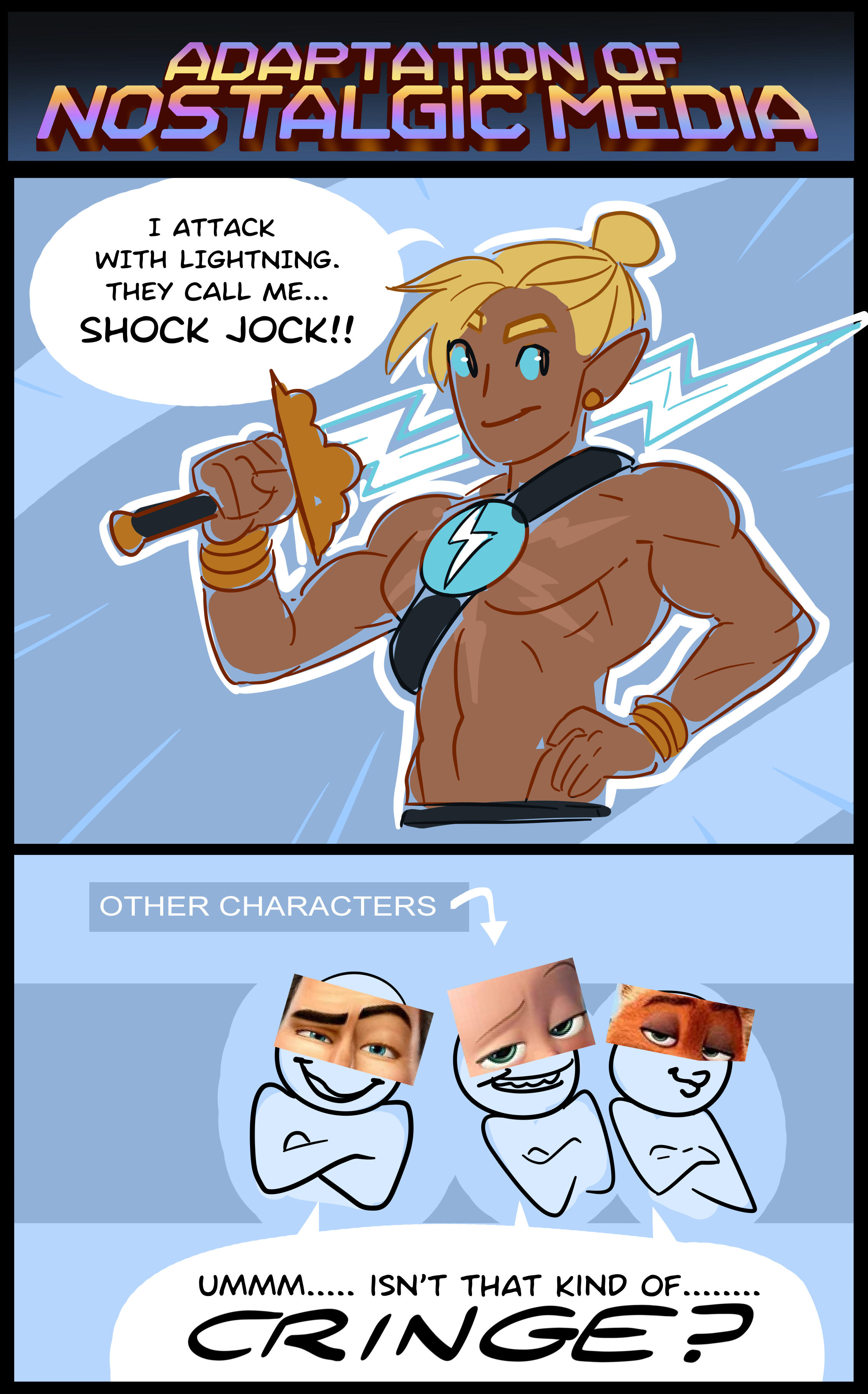
Deconstructive millennial writing is shit, because deconstructive millennial writers are shit. I could write a 9000 page thesis as to why, but the point is that you should really stop hiring people who are ashamed of the things that they're working on. Certain characters and their stories have been around for well over a century (or in the case of myths and folktales, millennia) so it's hard for that lengthy game of telephone not to have some kind of misstep over the years, Comic books are the prime example of this idea, with heroes such as Superman and Batman are more like pastiches of not just their source comics but also movie, video games, television, and radio shows (i.e. Kryptonite is actually from an episode of "The Adventures of Superman" radio serial from 1943). But there's a difference between giving an explanation for their capes, and going the full X-Men movie route and making fun of the stupid comic book costumes (which do not exist to make sense, they exist to attact the attention of the audience and invoke olympian strongmen).

I feel as if both creators and audiences are so afraid of being made fun of for what they like or work on, that they desperately clamber to reductively dismiss or mock their favourite franchises like: "Oh, yeah, naw, bro. I totally get that JoJo's Bizarre Adventure is gay and retarded, bro. I'm like, totally in on the joke too guys, hahah! Like, King Crimson, how does that work right? Looks like Araki forgot again! Hahah!" or something to that effect.

I don't expect the illustrious members of this forum to be afraid of what anybody has to say about what they like, but there's just something about that smug smirk those Dreamworks characters make just brings it out of me.
 
Totally feel this. It's 2026 and there were still games with that style of writing being shown at not-E3 this past week. It's so tired.

I think there was a time and a place for this kinda stuff. But like all bad ideas that somehow made money, they get drilled into the dirt infinitely.
 
It's tiring to me too. I'm certainly not against deconstruction or making fun of a trope, but there's a time and place and it isn't all the time. People are so scared of showing genuine enthusiasm for stuff because society has taught everyone not to show vulnerability or risk having your weaknesses taken advantage of or losing social capital. Everyone is on guard about everything.
 
Part of the problem here is that "post-modernism" took over really hard in a lot of Western writing spaces, especially in academia, and it's just entirely unhealthy as a practice since the whole premise of post-modernism is that it rejects everything that came before it through "deconstruction". There's a pretty good essay about this that I'm constantly citing in my Masters, I'll attach it. It's worth reading and is also very funny.

EDIT: I should probably add some additional content here, you can do a good deconstruction but it requires you to love the topic. Martian Successor Nadesico is probably the best example I'm aware of. If you aren't intimately familiar with the subject matter then you lack the context to both poke fun at it and to know which threads should be pulled on to make an interesting story. This is why Nadesico works and Evangelion doesn't. (EVA also suffers from relying too heavily on references to Ultraman while borrowing huge chunks from Dynamic-era Super Robot series, which really confuses it and causes a lot of its intent to fall flat. If it picked a lane it would probably do fine, but Anno was never going to take his meds for long enough to do that.)
 

Attachments

Last edited:
Part of the problem here is that "post-modernism" took over really hard in a lot of writing spaces, especially in academia, and it's just entirely unhealthy as a practice since the whole premise of post-modernism is that it rejects everything that came before it through "deconstruction". There's a pretty good essay about this that I'm constantly citing in my Masters, I'll attach it. It's worth reading and is also very funny.
Not all deconstruction is unhealthy. Sometimes re-examining existing tropes can actually create a worthwhile new work. The Simpsons was a deconstruction of family sitcom tropes and the first few seasons are genuinely good, but we don't think of it as a deconstruction anymore because that style of sitcom became the status quo and the Simpson got run into the ground. Madoka Magica is an eerie deconstruction of magical girl tropes, yet still retains and "reconstructs" some of them as still being valid within the context of the world it builds. The problem is psudo-intellectuals and people scared of being "cringe" feeling the need to preemptively deconstruct and ridicule everything all the time and with no desire to build something new with the pieces of what they deconstructed. Post-modernism is the status quo now, which defeats the entire purpose of it.
 
If you aren't intimately familiar with the subject matter then you lack the context to both poke fun at it and to know which threads should be pulled on to make an interesting story. This is why Nadesico works and Evangelion doesn't.
I personally don't see Evangelion as a deconstruction. The narrative deconstructs itself in an effort to look inward, but I don't think it deconstructs any genre tropes like people like to say it does.

I'm a little afraid to write more on this because I don't feel like I'm a deep enough otaku to have this opinion, but that's always the impression I've gotten.
 
That's why I decoupled post-modernism from deconstruction.
I personally don't see Evangelion as a deconstruction. The narrative deconstructs itself in an effort to look inward, but I don't think it deconstructs any genre tropes like people like to say it does.

I'm a little afraid to write more on this because I don't feel like I'm a deep enough otaku to have this opinion, but that's always the impression I've gotten.

The stuff it's working on is 70s- and 80s-era Super Robot and toku stuff, so by the time it landed in 1994, especially in the west, there wasn't really much context. If you haven't gone well out of your way to research older series from literally 50 years ago then you're going to have a shallow opinion on this one just by virtue of lacking the context.

It's kind of like reading Odyssey without reading Iliad. You can do it, but your understanding of the text will be limited by the lack of context.
 
Deconstruction may not be bad per se. However, like Ace put it, it's the post-modernist inclination to deconstruct something just for the sake of ridiculing the original, and not actually replacing it with anything of value. Like, the Simpsons may be a deconstruction of sorts, but it also created so much more, to the point where you don't even need to be familiar with with what they are referencing to find it enjoyable in itself (at least the first dozen seasons or so)..
 
What you are saying is that things lack "geniuine-tess" (amazing word speak skill I know) and are just afraid to be stupid, movies and AAA games always have to feel like they are in on the joke and meta.
Point is we need more stuff like that scene from madagascar where the gang goes to the subway and melman gets stuck on the door, crashes into the drumset and gets his head stuck in the clock.
 
Part of the problem here is that "post-modernism" took over really hard in a lot of writing spaces, especially in academia, and it's just entirely unhealthy as a practice since the whole premise of post-modernism is that it rejects everything that came before it through "deconstruction".
Evil cannot create, only corrupt.

Not to get another one of my threads closed, but this is a very Marxist way of viewing things. The idea of completely dissolving previously established ideas in order to supplant them with your own, primarily out of fear that ones new ideas can't hold against the tried and true concepts that came before. It's one of the horrid faces of modern writers, creative vampires who piggyback off of the marquee of a legacy franchise to get their foot through the door, constantly deriding older works through "decontruction" to pretend that they are avant-garde, while simultaneously stroking their egos and creating a stepping stone for other projects.

Martian Successor Nadesico is probably the best example I'm aware of.
Prince of Darkness is one of the hardest glowups in anime history, but Nadeisco is not a decontrstuction, it's a send-up and a loving tribute to space opera and mecha.
This is why Nadesico works and Evangelion doesn't.
I personally don't see Evangelion as a deconstruction. The narrative deconstructs itself in an effort to look inward, but I don't think it deconstructs any genre tropes like people like to say it does.
EVA is a deconstruction, similar to Boukurano in that it inspects the implications of throwing pubescent children into the fray of life-or-death situations, alongside the political angle of a world with such incredible concepts (something he bored us to tears with in Shin Godzilla).

However, it's not a particularly deep deconstruction, since all it really does is blankets itself in religious iconography to APPEAR deep but is really just "What if Mazinger Z, but fucked up?" with "What if children's cartoon, but fucked up?" being the most favoured flavour of lame "deconstruction".
I don't feel like I'm a deep enough otaku to have this opinion, but that's always the impression I've gotten.
You really worried about what a bunch of NERDS think? Fuck 'em, and their chinese cartoons. I but the majority of them don't even know what Anime really means, and how it's just a fake word they made up.
Not all deconstruction is unhealthy. Sometimes re-examining existing tropes can actually create a worthwhile new work.\
Deconstruction may not be bad per se.
No, it is not, but that goes without saying. Of course there are exceptions to every rule, and a rule for every exception. The problem of course is the lack of respect. Putting a twist on an old idea is fine, but if done so with a sense of disdain or apathy is unfair. The people that created Rings of Power show no respect for Tolkien's work, he's just some old white guy that keeps outselling them for some reason they refuse to comprehent. The people who created the Castlevania show do not care about the video games, they though Grant Dynasty was stupid, Christianity is bad, and wanted to be working on literally any other Vampire story then this one. But hey, those dumbass video game fans will watch it, and it will pay the bills so we can work on something like else.
The Simpsons was a deconstruction of family sitcom tropes
Nope, it was a parody of sitcoms, ironically being a parody of the Cosby show, which in itself was an answer to "Married...With Children" which was a parody of....family sitcoms like "Leave it Beaver". Time is a flat circle, and everything eventually comes back around to start. The audience will adore classic hoaky sitcoms, causing them to grow prevalent and become the norm, which will cause a reaction in the form of parodies, which will then take the place of the classic sitcom. Once the parody takes over, the joke runs tired, and people long for the classic genuine sitcom again.
Madoka Magica is an eerie deconstruction of magical girl tropes, yet still retains and "reconstructs" some of them as still being valid within the context of the world it builds.
Right, but it all just amounted to "What if cartoon, but fucked up?" so like EVA, it's not a particularly DEEP deconstruction.
The problem is psudo-intellectuals and people scared of being "cringe" feeling the need to preemptively deconstruct and ridicule everything all the time and with no desire to build something new with the pieces of what they deconstructed. Post-modernism is the status quo now, which defeats the entire purpose of it.
Nail on the head, it would actually be MORE groundbreaking to have everything be played purposely straight and withouth a twist, but I'm far from the first person to say that in the past decade or so. The pseudo-intellectual comment is less about the creators and more about the audience, while the creators are trying to stand out and be avant-garde so they can pretend their more sophisticated wrtiers than they actually are.
 
50037f_13222634.jpg

Deconstructive millennial writing is shit, because deconstructive millennial writers are shit. I could write a 9000 page thesis as to why, but the point is that you should really stop hiring people who are ashamed of the things that they're working on. Certain characters and their stories have been around for well over a century (or in the case of myths and folktales, millennia) so it's hard for that lengthy game of telephone not to have some kind of misstep over the years, Comic books are the prime example of this idea, with heroes such as Superman and Batman are more like pastiches of not just their source comics but also movie, video games, television, and radio shows (i.e. Kryptonite is actually from an episode of "The Adventures of Superman" radio serial from 1943). But there's a difference between giving an explanation for their capes, and going the full X-Men movie route and making fun of the stupid comic book costumes (which do not exist to make sense, they exist to attact the attention of the audience and invoke olympian strongmen).

I feel as if both creators and audiences are so afraid of being made fun of for what they like or work on, that they desperately clamber to reductively dismiss or mock their favourite franchises like: "Oh, yeah, naw, bro. I totally get that JoJo's Bizarre Adventure is gay and retarded, bro. I'm like, totally in on the joke too guys, hahah! Like, King Crimson, how does that work right? Looks like Araki forgot again! Hahah!" or something to that effect.

I don't expect the illustrious members of this forum to be afraid of what anybody has to say about what they like, but there's just something about that smug smirk those Dreamworks characters make just brings it out of me.

I wouldn't say it's a problem with mordern writing but a problem with an overreliance on meta humor and self referencial joke, an specific type of writing that tends to be percivied as witty but, if you try to sound witty all the time, it can wear off real fast and just sound pretentious.

Selfaware humor and meta humor only work if they are weaved into the narrative and are not the sole focus. Many times it seems like the writers setup entire scenarious just to make this type of quip. It gets old fast and you if you make all your dramatic buildup just a setup for jokes, they will never have weight.

Part of the problem here is that "post-modernism" took over really hard in a lot of Western writing spaces, especially in academia, and it's just entirely unhealthy as a practice since the whole premise of post-modernism is that it rejects everything that came before it through "deconstruction". There's a pretty good essay about this that I'm constantly citing in my Masters, I'll attach it. It's worth reading and is also very funny.

Imma be real with you chief, those "post-modernism" and "deconstruction" definitions you are using are more akin to their internet usages than their academic roots.
No, post-modernism does not simply "rejects everything that came before", it simply analyze things with a critical lens to reach a conclusion. While modernism was preocupied with making affirmations about things to set truths, post-modernism strives to go beyond and break them down, investigate and analyze to discover what make those truths, truths. A modern man speaks of truths and universal laws, a post-modern man question them, not necessarily to deny them, but to better understand them.

In the same vein, a deconstruction is not simply subvertion of expectations or taking something and make it upside down. Deconstrucion, in the original e truest sense, aims to pit two oposing sides together that are often put in dichotomies and analyze the root of their differences and how we percieve those oposing ideas.

Let's take the classic "show, don't tell". Here we have "show" in oposition to "tell", having "show" used as better alternative while "tell" in a lesser option. A deconstruction would strive to understand the root of this attribution of value between these two concepts and question if they really are so different from oneanother or if we can even decide if one is good and the other is bad.

Martian Successor Nadesico is probably the best example I'm aware of. If you aren't intimately familiar with the subject matter then you lack the context to both poke fun at it and to know which threads should be pulled on to make an interesting story. This is why Nadesico works and Evangelion doesn't.

Eva is not a deconstruction, it was never intended to be one and wasn't even the first one to do what it did. Nadesico is just a parody, it plays around with tropes from old robot anime but it also play those tropes straight in a mix of homage and meta humor.
 
I will never understand why companies hire people who openly dislike the source material.
That's because the out-of-touch old men at the top think they are dealing with undiscovered geniuses who just happen to "get it" — happens on every industry.
 
I regret trying to discuss Eva lol... Always a bad idea.

Never seen this many Anno dislikers in one place, that's kinda fun!
 
I can't believe there are still people who say NGE was a deconstruction in the big 2026.

Like how is it a deconstruction? It's not actually deconstructing anything about the genre, unless you just have the most shallow stereotypical views of mecha as a genre. It's a love letter to the genre more than anything.

Like Anno and the others at Gainax were and are huge ass mecha and tokusatsu (and 70s British televised science-fiction) nerds.
 
Imma be real with you chief, those "post-modernism" and "deconstruction" definitions you are using are more akin to their internet usages than their academic roots.
No, post-modernism does not simply "rejects everything that came before", it simply analyze things with a critical lens to reach a conclusion. While modernism was preocupied with making affirmations about things to set truths, post-modernism strives to go beyond and break them down, investigate and analyze to discover what make those truths, truths. A modern man speaks of truths and universal laws, a post-modern man question them, not necessarily to deny them, but to better understand them.

In the same vein, a deconstruction is not simply subvertion of expectations or taking something and make it upside down. Deconstrucion, in the original e truest sense, aims to pit two oposing sides together that are often put in dichotomies and analyze the root of their differences and how we percieve those oposing ideas.
Not really. Most of the biggest names of Post-Modernism, such as Derrida & Foucault, heavily pushed the idea that there is no such thing as objective "truth." Hence their whole mission was to destroy by deconstruction, and they dressed up a bunch of nonsense with a bunch of flowery language that would confuse most people for decades. They used the same thing to "deconstruct" things like 'age of consent,' because they were also pedos..
 
Evil cannot create, only corrupt.

Not to get another one of my threads closed, but this is a very Marxist way of viewing things. The idea of completely dissolving previously established ideas in order to supplant them with your own, primarily out of fear that ones new ideas can't hold against the tried and true concepts that came before. It's one of the horrid faces of modern writers, creative vampires who piggyback off of the marquee of a legacy franchise to get their foot through the door, constantly deriding older works through "decontruction" to pretend that they are avant-garde, while simultaneously stroking their egos and creating a stepping stone for other projects.


Prince of Darkness is one of the hardest glowups in anime history, but Nadeisco is not a decontrstuction, it's a send-up and a loving tribute to space opera and mecha.


EVA is a deconstruction, similar to Boukurano in that it inspects the implications of throwing pubescent children into the fray of life-or-death situations, alongside the political angle of a world with such incredible concepts (something he bored us to tears with in Shin Godzilla).

However, it's not a particularly deep deconstruction, since all it really does is blankets itself in religious iconography to APPEAR deep but is really just "What if Mazinger Z, but fucked up?" with "What if children's cartoon, but fucked up?" being the most favoured flavour of lame "deconstruction".

You really worried about what a bunch of NERDS think? Fuck 'em, and their chinese cartoons. I but the majority of them don't even know what Anime really means, and how it's just a fake word they made up.


No, it is not, but that goes without saying. Of course there are exceptions to every rule, and a rule for every exception. The problem of course is the lack of respect. Putting a twist on an old idea is fine, but if done so with a sense of disdain or apathy is unfair. The people that created Rings of Power show no respect for Tolkien's work, he's just some old white guy that keeps outselling them for some reason they refuse to comprehent. The people who created the Castlevania show do not care about the video games, they though Grant Dynasty was stupid, Christianity is bad, and wanted to be working on literally any other Vampire story then this one. But hey, those dumbass video game fans will watch it, and it will pay the bills so we can work on something like else.

Nope, it was a parody of sitcoms, ironically being a parody of the Cosby show, which in itself was an answer to "Married...With Children" which was a parody of....family sitcoms like "Leave it Beaver". Time is a flat circle, and everything eventually comes back around to start. The audience will adore classic hoaky sitcoms, causing them to grow prevalent and become the norm, which will cause a reaction in the form of parodies, which will then take the place of the classic sitcom. Once the parody takes over, the joke runs tired, and people long for the classic genuine sitcom again.

Right, but it all just amounted to "What if cartoon, but fucked up?" so like EVA, it's not a particularly DEEP deconstruction.

Nail on the head, it would actually be MORE groundbreaking to have everything be played purposely straight and withouth a twist, but I'm far from the first person to say that in the past decade or so. The pseudo-intellectual comment is less about the creators and more about the audience, while the creators are trying to stand out and be avant-garde so they can pretend their more sophisticated wrtiers than they actually are.

This whole post reminds me of the Devil May Cry netflix anime and how a random nobody (Adi
Shankar) wanted to remake Devil May Cry and make it his "own" project, that's why he was so angry when Devil May Cry 5 was announced because he couldn't gaslight people into thinking he whas the father of DMC anymore.

It's all about this talentless nobodies with "main character sindrome" that want to make every story about themselves, while also hijacking other people's creations and changing them to fit their narrative and ideologies.
 
This whole post reminds me of the Devil May Cry netflix anime and how a random nobody (Adi
Shankar) wanted to remake Devil May Cry and make it his "own" project, that's why he was so angry when Devil May Cry 5 was announced because he couldn't gaslight people into thinking he whas the father of DMC anymore.

It's all about this talentless nobodies with "main character sindrome" that want to make every story about themselves, while also hijacking other people's creations and changing them to fit their narrative and ideologies.

Adi Shankar is on a ego trip 24/7. A writers room full of people who don't understard/don't care the source material and only cough up whatever the higherups want is still much less offensive than what Shankar does with the only goal of stroke his ego and promote himself as this genius writer
Post automatically merged:

heavily pushed the idea that there is no such thing as objective "truth."
If a "truth" can't hold it own when slightly questioned, than I think they can hardly be called a truth at all.

Again, it's not about trying to destroy truths, it's about better understand them. I think the greatest lesson here is not to accept them blindly out of convenience, fear or because they benefit you.
 
Last edited:
What ends up happening is that deconstruction is used as a carte blanche to do whatever the hell writers want to do with the material while still appearing to be knowledgeable. I've nothing against whatever people want to do with adaptations, knock yourself out, but it is my right to not watch or recommend what I see as blatantly off key.
 
I can't believe there are still people who say NGE was a deconstruction in the big 2026.

Like how is it a deconstruction? It's not actually deconstructing anything about the genre, unless you just have the most shallow stereotypical views of mecha as a genre. It's a love letter to the genre more than anything.
It's specifically targeting cliches and formulas that existed in 70s- and 80s-era Super Robot works. This is why I brought up that most people lacked context by the time it landed, and today if you want to see the things EVA is based on you need to go back literally 50 years. However, it doesn't do a very good job of it and its runaway success with its audience ended up doing massive damage to the industry in the next 15 years since everything tried to clone it. (Some good did come of it - Fafner is a clone that does the same thing but way better, but it unfortunately turned into a franchise and became absolute slop by the time it finished.)

The extremely sketchy writing and directing when Anno is around also really hurt the work. This is most obvious during the "Battle Arc", when Anno was on sabbatical - the series has actual character development for the first time. The lack of coherency, especially early on, really hurts the honestly pretty good ideas it starts with:
"Secret lab that runs giant robots that are the only things that can fight the monster of the week, headed by the protagonist's father" is the standard Dynamic-era setup. It, or variants of it, can be found in pretty much all your classic SR series (even dark ones like Zambot), and it also rears its head in Mobile Suit Gundam and Mobile Suit Zeta Gundam (although those are borderline a parody as by that point it was already an old cliche - even in this era there were works that played with the formula like Ginga Senpuu Braiger). Where it starts turning this interestingly is that it then thinks about how this might work in reality, where things like governments and government militaries exist and you need money to run an operation like this, let alone to run an operation like this and be active more than once. That the monsters of the week are cosmic horrors and the fighting can get pretty brutal - and often isn't pretty to look at - runs in direct contrast to both your Dynamic-era series and Ultraman, Anno's one true love (in which Ultraman is legendarily brutal but this is consistently portrayed as a good thing, Greek hero style). The decision to make the protagonist a wimp and have the battles take a toll on the psyche of everyone involved is both realistic and very unusual for the genre it's working in, and seeing that is genuinely pretty interesting. It also works in contrast to how this genre usually goes - the protagonist is usually rough and ready and often a competent fighter in their own right, but Shinji is a mouse. On top of that, his relationship with his father figure is poor, which is almost unheard of in the genre. (Jeeg technically approached this but it never dwells on it too deeply.)
There's an actually good premise here, but the franchise never lives up to it and, perhaps most importantly, there's a distinct lack of love for one of the two things it apes, which makes the attempt fall flat. Being Japanese also doesn't really help the "mental strain" aspect of it because despite the project being headed by a depressive who actually got treatment, Japan to this day is not big on acting like stress and mental strain (and mental illness) are real things, which drags down its attempts to get into the character drama quite a bit.

That being said, if you do like your older toku things, I can strongly recommend Anno's "Shin" movie series. He's a much better director when he's on a leash. Shin Kamen Rider in particular is fantastic.

(post too big so I have to split it in two)
 
I can't believe there are still people who say NGE was a deconstruction in the big 2026.

Like how is it a deconstruction? It's not actually deconstructing anything about the genre, unless you just have the most shallow stereotypical views of mecha as a genre. It's a love letter to the genre more than anything.

Like Anno and the others at Gainax were and are huge ass mecha and tokusatsu (and 70s British televised science-fiction) nerds.
I view Evangelion as less of a deconstruction and more of a mental breakdown and hard life lesson about connection with others delivered through what is a mecha anime on the surface, but I'm also not an expert on mecha tropes so I'm likely missing a lot. A lot of the lessons Eva presents probably aren't news to well adjusted people, but people with social anxiety, trauma, or just limited life experience from being young probably needed to hear it.

Right, but it all just amounted to "What if cartoon, but fucked up?" so like EVA, it's not a particularly DEEP deconstruction.
I like how Madoka Magica both deconstructs and reconstructs. Yes, it reinterprets tropes to be more fucked up, like what if the cute animal giving you powers had ulterior motives and what if being a magical girl warrior was more like being a child soldier. But it still retains, at least in the end of the original series, that hope and love are still positive and magical forces for change and not just cringe naivete.
 
Returning to the main topic, one of the big issues in academia is that the infection of "post-modernism" has lead to a lot of "the text says this, because I say so". When I began in this field you had to actually cite the text when you wanted to make a point, but today you would never ever do something as crude as actually cite the text. Instead, you need to find a paper by an academic that agrees with you and cite that instead. You might spot the obvious flaw in this method.
To make matters worse, this has pretty huge crossover with twitter activism. A lot of modern output is "classic text is bad, actually" on the grounds that it's not sufficiently feminist or w/e, and that goes hand in hand with "analysts" believing that postmodernism is inherently virtuous. The paper I attached actually has a whole segment that goes over this (in my first post in this thread), but I'll give an example that you're probably more familiar with, the "TOLKIEN WAS ACTUALLY MEGA RACIST" thing.

Occam's Razor: by today's standards, Tolkien probably did hold views that would be considered racist. However, that's not something you can declare on the basis of his body of work: his seminal work speaks of the need for many different races (or more accurately, species - not the same race with different pigmentation) to cooperate and band together and be better for it. The orcs are almost certainly not a stand-in for a given race, but rather a stand-in for the unnamed and yet overwhelming armies of the great epics of the end times, like in the Norse Ragnarok. Actually, Tolkien's notes indicate that he didn't believe any species or race could consist of always-evil creatures, but ultimately conceded the point for the sake of the story - and even then, it's noted that the orcs aren't naturally-occurring creatures, but bioweapons created through sorcery.
But... in post-modernism, there's no context. "When I read a text, it means exactly what I mean it to mean."

It is, however, possible to be opposed to the 'dominating global culture' and still question the rather simple equation: asserting local identity = diversity = good (or indeed the implication that all 'European histories' have been narratives of progress, and that making causal connections is somehow suspect). For example, the assertion of local Serbian 'identity' resulted in the bloody and brutal siege of Sarajevo between 1992 and 1996, and 'local identities' all over the world are all-too-often defined in opposition to the immigrant 'other'. Meanwhile the dominating global culture' - i.e. multinational capital - is often very much in favour of the immigrant 'other' because s/he provides cheap labour. This undermines the efforts of poorly paid indigenous workers to raise wages, which can then provoke them to 'assert their local identity' in ways that can be virulently racist. The implication that all assertions of local identity are ipso facto good ignores this crucial complication.

The writings of those who call for theory in creative writing often make such ambiguous and problematic claims on the 'progressive' or 'oppositional'. David Hawkes argues that this has been 'one of postmodernism's most subtle manoeuvres':
The humanities departments of Western Universities ring with denunciations of the dominant, or 'hegemonic' culture, and postmodernism allies itself firmly with the 'oppositional' and the 'counter culture' ... we are asked, in rigorously suggestive terms, to applaud the 'free play' of 'difference', and eschew the rigidities of philosophies that 'totalize' ... although the details are left suspiciously vague, there is a sense across the intellectual spectrum that postmodernism is a radical, subversive and oppositional mode of thought. (Hawkes 2003: 11)

The student movement was flushed off the streets and driven underground into discourse. Its enemies, as for the later Barthes, became coherent belief systems of any kind ... conceptual meaning itself ... was feared as repressive. (Eagleton 1983: 142)

But the revolutionary work of deconstruction continued and, like all revolutions, soon started to eat its own. So, when the poststructuralist-Lacanian-feminist Julia Kristeva demolished the idea that the feminine, like the self and the individual, had an essential biological or psychic existence, claiming that it could in fact be manifested by men, other feminists pointed out the basic problem with such positions:
to accept the arguments of a strong postmodernism is to raise uncertainty about the existence of a specifically female subject and inevitably, therefore, about the very possibility of political agency for women ... as a political practice, surely feminism must continue to posit some belief in the notion of effective human agency, the necessity for historical continuity in formulating identity and a belief in some kind of historical progress. (Waugh 2001: 347)

Patricia Waugh then goes on to point out that 'strong' postmodern critiques, for example, those of Lyotard:
seem to entail the view that feminism has no more legitimacy than any other political language game. Within the terms of 'strong' postmodernism one could not even make an unconditional claim that it is wrong to oppress women. (Waugh 2001: 349)

Much the same point could be made with reference to the oppression of poor people, children or, indeed, anyone.

The drive within poststructuralism to deconstruct everything,including itself, poses a serious problem for anyone wanting to use it as a basis for radical action, or any kind of evaluation. For:
if meaning ... was a passing product of words or signifiers ... did it make sense to claim that one interpretation of reality, history, or the literary text was 'better' than another? (Eagleton 1983: 133-44)
(You'll note the quotes here use the term "post-structuralist"; this is a useful distinction in this paper's context but you can essentially read this as "post-modernist" in the context of the thread, as it's being used in this sense. The lay person likely won't have heard of "post-structuralism" since it was largely confined to academic circles prior to "post-modern" becoming a media aesthetic.)
 

Users who are viewing this thread

Connect with us

Support this Site

RGT relies on you to stay afloat. Help covering the site costs and get some pretty Level 7 perks too.

Featured Video

Latest Threads

ISO to CHD

Hey everyone, how's it going? I wanted to ask if it's worth converting a PS2 ROM to CHD format...
Read more

The Most Underrated Pro Wrestler Ever

Alright Folks. The wrestling community gotta come together because it is criminalizing to not...
Read more

Japanese Sci-Fi

I've been looking for something to scratch that itch after watching Foundation and was curious...
Read more

Online statistics

Members online
136
Guests online
1,267
Total visitors
1,403

Forum statistics

Threads
20,119
Messages
508,880
Members
928,485
Latest member
xiwis02

Today's birthdays

Advertisers

Back
Top