Genesis Lets Talk about the Sega Genesis Megadrive, the videogame console that forced Nintendo to do discounts on the Super Nintendo

bcdusk

Paladin Knight
Level 1
57%
Joined
Dec 17, 2024
Messages
68
Level up in
32 posts
Reaction score
118
Points
377
While the Sega Master System was a decent success in Europe and South America (mostly in Brazil), it failed to make any strong dents in the North American and Japanese markets. The hold of the NES/Famicom was too strong, and the Master System wasn't different enough to topple the juggernaut.

So Sega decided to just top it. Nintendo were complacent with their success and dragging their feet on developing a 16-bit system, which was the arcade standard at the time. They were already being impacted in Japan by the sudden success of NEC's PC Engine (TurboGrafx-16 in the West) which, while not actually 16-bit, was a noticeable technical improvement from the Famicom, which was underpowered even for its time. Thus, Sega decided that they would beat Nintendo to the punch with a console based on their System 16 arcade board (codenamed "Mark V").

Enter the Mega Drive or, as North Americans refer to it, the Sega Genesis, released in 1988 in Japan, 1989 in North America, and 1990 elsewhere.

For the most part, it worked. Outside of Japan, anyway. The Japanese Mega Drive's two launch titles, Space Harrier II and Super Thunder Blade, created a poor first impression among gamers, as the console lacked the hardware-based sprite scaling and rotation that powered their Arcade Game predecessors. The Mega Drive also had the misfortune of launching in Japan in the midst of a global chip shortage, which forced major ROM size cutbacks to a number of launch window games (particularly Osomatsu-kun Hachamecha Gekijou). Hideki Sato, then head of Sega's R&D unit, would later lament the problems the Mega Drive launch lineup faced in interviews, which would hurt the reputation of the Mega Drive in Japan for most of its life. Things got even worse for the system even before launch as Super Mario Bros. 3 was released a week prior, which greatly overshadowed the Mega Drive's launch.

The Western market was a different story. It was nursed along by Nintendo's region lock policy, meaning that if you made a game for a Nintendo console you couldn't release that same game in any other videogame console, which was viewed by some developers as a violation of anti-trust regulations. Those same developers flocked to Sega due to the latter's apparent laxity; Sega were angling toward the same kind of lockout policy until Electronic Arts broke the mechanism behind how Sega Genesis cardridges worked and then, characteristically, threatened to leak the details out to other third parties unless Sega agreed to more favorable terms. At any rate, Nintendo voluntarily dropped a lot of these exclusivity policies later but not late enough that many games weren't affected.

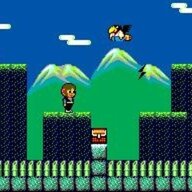
What made this console such a hit in the West was a shift in Sega's target audience early in its lifecycle. During the Master System era, Sega made a grab for the same kiddie demographic as Nintendo. The Genesis/Mega Drive initially did the same, as evidenced by their original mascot platformer Alex Kidd in the Enchanted Castle, a sequel to the Master System's Alex Kidd in Miracle World.

However, Enchanted Castle was a severe critical and commercial failure, especially in western countries, mostly due to being too short, using Janken matches much more that Alex Kidd in Miracle World and despite improved graphics feeling overall as not as good as the Master System game.

What really captured the public's imagination instead was Altered Beast (1988), a hastily-made but mostly fairly-accurate port of Sega's arcade hit which came bundled with most of the consoles. A few months later, the system had its first standalone hit, Michael Jackson's Moonwalker, adapted from the 1988 film of the same name and driven by the sheer star power of its lead figure at the time. It was obvious to Sega that they weren't going to get anywhere trying to appeal to Nintendo's audience, and that the answer lay in the burgeoning demographic of teens and young adults with disposable income, who largely preferred home computers before the console's launch. Many early titles had complex gameplay and/or nightmarish imagery one wouldn't expect of any other console game. Sega took a page from the licensing deal Nintendo made with Mike Tyson, and struck similar endoresment deals for many of its early sports games, such as Tommy Lasorda Baseball, Arnold Palmer Tournament Golf and Joe Montana Football. The kerfuffle with EA would also wind up paying dividends, as the Genesis version of John Madden Football attracted sports fans to the system and gave the console another edge over the NES.

Sega gathered the minds behind Alex Kidd and tasked them with coming up with a replacement mascot who could appeal to this older audience. The design process was lengthy and involved extensive market research, on-the-street interviews and polls, some of them conducted in the United States. In the summer of 1991, they finally managed to come up with a Killer App known as Sonic the Hedgehog 1, which was made the Genesis's pack-in and truly kickstarted its success. The following year's sequel, Sonic 2, was even more successful and cemented Sega as a force to be reckoned with in the console market. Its biggest breadwinners ended up being their family-friendly fare, namely the Sonic series and Virgin's Aladdin. The Mickey Mouse game Castle of Illusion was another early hit for the console, and there were plenty of other E-rated and below exclusives coming down the pipe, like a Barney the Dinosaur edutainment game and Treasure's McDonald's Treasure Land Adventure (the latter has no business being as good as it is). The Genesis/Mega Drive sold 40 million units, with miniaturized versions and handhelds still on the market today, but most of those being of terrible quality.

Although the Mega Drive flopped in its home country, which was already embroiled in a war between the Famicom and the PC Engine, Sega of America's and Sega of Europe's adept marketing broke Nintendo's stranglehold on the Western market (while the TurboGrafx-16 was squeezed out of the market by both competitors there), redefining the landscape for both companies and consumers and giving the Big N its first real competition in the home console business, the Genesis also got success in Europe thanks to European-heavy IPs at that time. Nintendo eventually deployed their own 16-bit console in the form of the Super NES/Super Famicom.

The Genesis and SNES had a long and fierce rivalry in the west which is the best-remembered Console War of all. Sega brazenly championed the technological superiority of 16-bits as a marketing point over the 8-bit NES: a "16-bit" nameplate was loudly plastered on the console, and their port of Strider was advertised as one of the biggest games of its day due to the fact that it was the first Sega game to use an 8-Megabit cartridge. After Nintendo upgraded to their own 16-bit console that was technically superior to the competition in many respects, Sega of America decided to change strategies and instead advertise the "Blast Processing" power of the Genesis, whatever that meant; it was just a marketing ploy to spin how the console had a faster processor than the SNES. To be fair they weren't wrong, several SNES games are infamous for being too slow.

Sega even planned Sonic 3 & Knuckles to be a then-staggering 34-Megabit cartridge, but when it became far too expensive for them to manufacture (along with the game being rushed down the pipeline due to a tie-in deal with McDonald's), they were forced to split the game in half; the latter release had a specialized Lock-On Technology cartridge which allowed the game to be played in its intended length.

After the roaring success of Donkey Kong Country and the Super FX chip powering Star Fox 1 and Super Mario World 2: Yoshi's Island put the SNES over the top, Sega were spooked into green-lighting Sonic 3D: Flickies' Island and Vectorman, along with a console port of Virtua Racing. The latter came with the Sega Virtua Processor, Sega's own take on the Super FX chip, which allowed for more-complex polygonal rendering. It was in fact more powerful than the Super FX chip. Virtua Racing also happened to be the most expensive cartridge ever produced for the console, and the disappointing sales convinced Sega's marketing department that there was no future in it.

The very same Nintendo/Sega rivalry would find a new light in 2019 when Sega responded to Nintendo's release of Classic Mini Plug 'n' Play Game systems with their own Sega Genesis Mini (called the Mega Drive Mini outside North America). The system would release worldwide on September 19, 2019. In 2021, Nintendo introduced an Expansion Pack for its Nintendo Switch Online service, which includes a library of Sega Genesis games. New games are added to the library every so often. Nintendo also introduced a replica three button Genesis controller that can be used with the Switch. In 2022, following the Mini's massive success, Sega revealed the Sega Genesis Mini 2 (again named the Mega Drive Mini 2 outside North America), modelled after the Genesis Model 2 and featuring another 50+ games, including a number of Sega CD which was released natively in Japan and via import in North America and Europe on October 27 of that year.

The Sega Genesis lasted a ridiculous amount of time in Brazil, even today while the console has finally being discontinued for years, toys of bad quality that let you play Sega Genesis games and or Master System games can still be bought in Brazil. Those cannot be considered to be real Sega Genesis models as they lack the ability to play Sega Genesis cardridges.
 
Last edited:
Where is the part about discounts? Is there a second post coming or something?
 
Where is the part about discounts? Is there a second post coming or something?

Nintendo was forced to drop the Super Nintendo price and include a game to compete.

The Sega Genesis literally had a bundle of a Sega Genesis Model 1 and Sonic 1 by 50 dollars less that what Nintendo was selling the Super Nintendo, plus a game.


Most common Pack in Super Nintendo games were Super Mario World, Super Mario All Stars, Super Mario All-Stars + Super Mario World that was only sold as a pack in and of course Donkey Kong Country.
While the Nintendo console launched at 200 dollars that was just with the console, however a bundle with Super Mario World at the same price did follow after that.

Super Mario All Stars was quickly made to basically be a Super Nintendo pack in title more that anything else,


Sega best deal with the Sega Genesis was the one that included both Sonic 1 and Sonic 2.


Here is how the price cuts went down:

 
this could be a solid article with a bit more polish. The writers guild here is always open to submissions.

This is 98% ripped right from TV Tropes and this is basically a thread to talk about the Sega Genesis, not yet another article about the Sega Genesis.
 
This is 98% ripped right from TV Tropes and this is basically a thread to talk about the Sega Genesis, not yet another article about the Sega Genesis.
oh lol, well that's not good. If you want to start discussion the least you can do is write your own intro.
 
Excellent write-up.

Reading about the 16-bit console wars never ceases to entertain me. That, and watching old ads from that era.
 

Users who are viewing this thread

Connect with us

Support this Site

RGT relies on you to stay afloat. Help covering the site costs and get some pretty Level 7 perks too.

Featured Video

Latest Threads

Game awards 2025

Have you all already watched the show? What are your opinions? Are you satisfied or disappointed?
Read more

I want to translate a game into German

The lack of fan translated games into German can be frustrating at times it’s like a barren...
Read more

DESIGN A ROBOT MASTER FOR MEGA MAN: DUAL OVERRIDE!

Street Fighter movie Sneak Peek...


I'm not sure what to think. 1 flash kick but not much in special moves or...
Read more

TGA 2025: The Good, the Weird, and the Expected

Clair Obscur: Expedition 33 swept everything.
Leon is going to be the action-heavy part of the...
Read more

Online statistics

Members online
55
Guests online
963
Total visitors
1,018

Forum statistics

Threads
15,357
Messages
371,692
Members
896,562
Latest member
Stellaellarlla

Today's birthdays

Advertisers

Back
Top