The Pieces of the Puzzle
There are games that wait decades to be played, and when their moment finally comes, you realize they were the missing piece of a puzzle you’ve been assembling for a long time.
The main pieces of this puzzle are:
Chrono Trigger, of course.
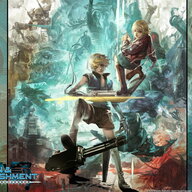
Angel’s Egg, by Mamoru Oshii.
(For the record: The film has just been released in theaters in Japan and North America, and it will soon be released in Italian theaters for the first time thanks to Lucky Red!
On that note, the 4K Ultra HD Blu-ray of the remaster is already on sale and, above all, the Angel’s Egg: The Visual Collection artbook can be ordered, for example, in cdjapan.
Arthur C. Clarke
(In this case,
Childhood’s End /
Le guide del tramonto)
Neon Genesis Evangelion: which, well, raised us and never let go.
Let’s pick up the thread where we left off: Chrono Trigger.
You know it by heart by now, but I need to remind you of the famous Dream Team that developed the game:
Hironobu Sakaguchi (producer of the Final Fantasy saga)
Yuji Horii (director of the Dragon Quest saga)
Akira Toriyama (no comment needed)
Nobuo Uematsu (composer of the Final Fantasy series soundtracks)
and
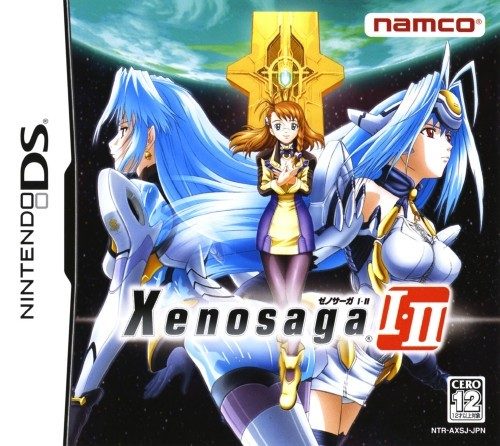
Tetsuya Takahashi (Final Fantasy IV, V, VI, Chrono Trigger and, the reason we’re here, the sequel to Chrono Trigger and the twin of Final Fantasy VII: Xenogears)
Genesis
It’s 1995, Chrono Trigger and Final Fantasy VI have just been released, and Squaresoft obviously intends to continue the saga with the seventh chapter. Takahashi worked on the previous FF installments and, together with Soraya Saga, has an idea for a videogame that pushes even further the more mature narrative shift FF VI had imprinted on the series. The bosses at Square like the idea so much that Takahashi, who had never written a single line of text in his life, is immediately put to work on the script for FF VII.
When the first draft arrives on the Square executives’ desk, they are blown away. Nothing like it had ever been seen before: for the first time in videogame history, a story had been written for a truly adult audience, and to be fully understood it required adult knowledge. It’s not just a complex and mature story—already rare enough—it’s trying to communicate an actual philosophy. Playing it today, I think it was perhaps the first videogame created with the precise goal of telling a story—or rather, of communicating a vision (of the world, of humanity, of life). Today it would be thrown out without appeal, but at the time money was pouring in (the FF saga, Secret of Mana—also with Takahashi—Chrono Trigger), and the development costs of one misguided game didn’t risk bankrupting the company. So Square, in a move that was still very forward-looking, decided to give the green light.
Some pillars of the game were defined—Cloud and Shinra above all—but Takahashi’s script was too complex, full of extreme sci-fi, cultural references that were too highbrow (Sigmund Freud, Jacques Lacan, Carl Jung), and with too little fantasy to fit into the Final Fantasy canon.
Fortunately, Takahashi had just finished working on Chrono Trigger, which was doing extremely well, so Square decided to put him in charge of the team that would develop a generic Chrono 2, with much of the staff who had worked on Chrono 1. But after just a few weeks, it became clear that the lighthearted, playful world of Chrono Trigger was too constraining for Takahashi, and Square agreed to his umpteenth request (God, I wish I had bosses like that): to create a new IP, developed by much of the team that had made Chrono Trigger.
Naturally, the title was changed, and Chrono Trigger 2 became:
Xenogears.
The Union of the Puzzle Pieces
The core idea came from Soraya Saga (here pictured with director Ron Howard), also a Squaresoft employee and later Takahashi’s wife:
“I came up with an idea about a deserted A.I. with feminine personality who becomes an origin of new mankind in the unexplored planet. Takahashi refined the idea into more deeper and mystic love story.”
— Soraya Saga
There are various points of contact among Angel’s Egg, Neon Genesis Evangelion, and Xenogears, but the main one, in my opinion, is that they were all created to communicate something. Not just to entertain, not just to tell a story (already rare for videogames), but to allow a very specific person—the author—to communicate with the audience. You can feel the force and necessity to communicate coming directly from the author. In cinema this isn’t unheard of, especially in more independent projects, but for anime—and even more for videogames—these are practically unique cases.
(The reason why, in 2025, books and comics are still around despite cinema, TV, streaming, animation, and videogames is that in this respect printed paper is unmatched and unbeatable. Many works—especially debuts—are born from the individual’s need to express something, and that is what makes the difference compared to any other medium.)
The internet is full of endless reviews and analyses of the innumerable philosophical references in the game (which I have no intention of tackling); what interests me is highlighting its connection with spiritually akin works. Xenogears is to Takahashi what Evangelion is to Anno and Angel’s Egg is to Oshii.
It’s well known that Anno created Evangelion during a period of depression, isolation, and existential emptiness; the series was born directly from this crisis and from his desire to give meaning to his personal experience. The work is a catharsis for Anno (or at least an attempt at one), a way of exploring/giving shape to alienation and the difficulties of self-acceptance and connection with others.
People say Mamoru Oshii created Angel’s Egg after losing his faith (not true: this belief arose from a biblical error due to a mistranslation in a very old interview, which then became the camel passing through the eye of the needle), but it is true that the film is his personal reflection on religion, the meaning of existence, and the destiny of mankind.
Elective Affinities
And so, Xenogears is for Takahashi exactly the same thing, with the difference that while literature and cinema were already mature media, Takahashi took an expressive medium that was still quite embryonic in this respect and turned it into a mature intellectual discourse.
This is not meant to be a hagiography: the inexperience of an author who had never directed a videogame in his life, and who—astonishingly—found himself with virtually total freedom to create one of the most ambitious games ever conceived, ended up producing something far from flawless.
Exactly like Evangelion, the work reaches the end with its breath short, its wallet empty, and fighting tooth and nail not to succumb to reality. For comparison: at that time Square took about one year to develop a Final Fantasy entry, while Xenogears required two—and even that wasn’t enough to fully realize the wild vision of Tetsuya Takahashi and his wife Soraya Saga. In hindsight, you could say that even four wouldn’t have been enough to achieve what they had in mind. (In their defense, they realized this at some point and asked to publish the game in two parts; but, just as it’s considered taboo today, at the time Square categorically rejected the request as absurd and understandably pulled the plug.)
Overall, though, despite the more than 60 hours required (even with the Perfect Works edition, which includes all the QoL features possible without access to Square’s source code), I’m glad that after thirty years I was finally able to play it.
For those who don’t want to waste time reading the whole review but want a sense of what we’re talking about, I’ll leave this authorless paragraph that, in two sentences, says everything I said in two pages:
“I think I still love this game. This was clearly an attempt to make the best game of all loving time. Not the greatest RPG, not the best game of the year, they thought they were making The Greatest loving Game Ever. As crazy as all of it was, I just find the whole thing charming. They wanted to make something that would be taught in video game literature classes in the year 2356 AD and just spewed their crazy all over the place unabated until Square kicked in the door and stopped the party.”












 . Not to mention that anime is loosely based on Episode I.